


I really don’t want to be a LinkedIn influencer. Please. Please. Please. Don’t make me become a LinkedIn influencer.
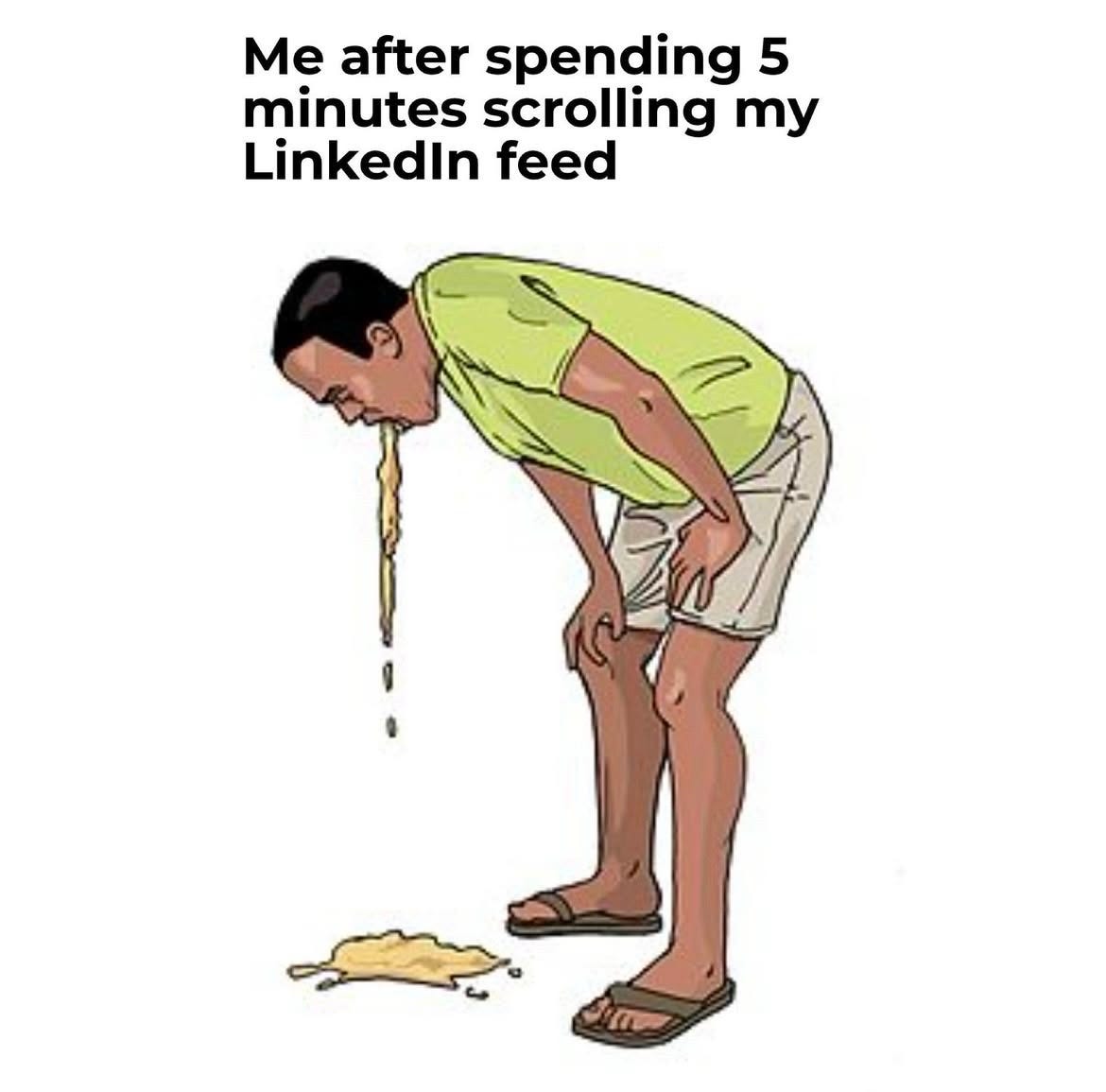
Unfortunately, it has essentially become a job requirement for B2B startup founders (I fall into this category) and C-suite business leaders to post thought leadership on LinkedIn to grow their businesses. Actually, hold up, it feels like more than a job requirement. At this point it may actually be the most important part of the job. This is most true in the startup space — where founders take an attention-by-any-means-necessary approach to getting their product in front of potential customers, while established corporate brands hold a tighter leash around what their leaders can say publicly.
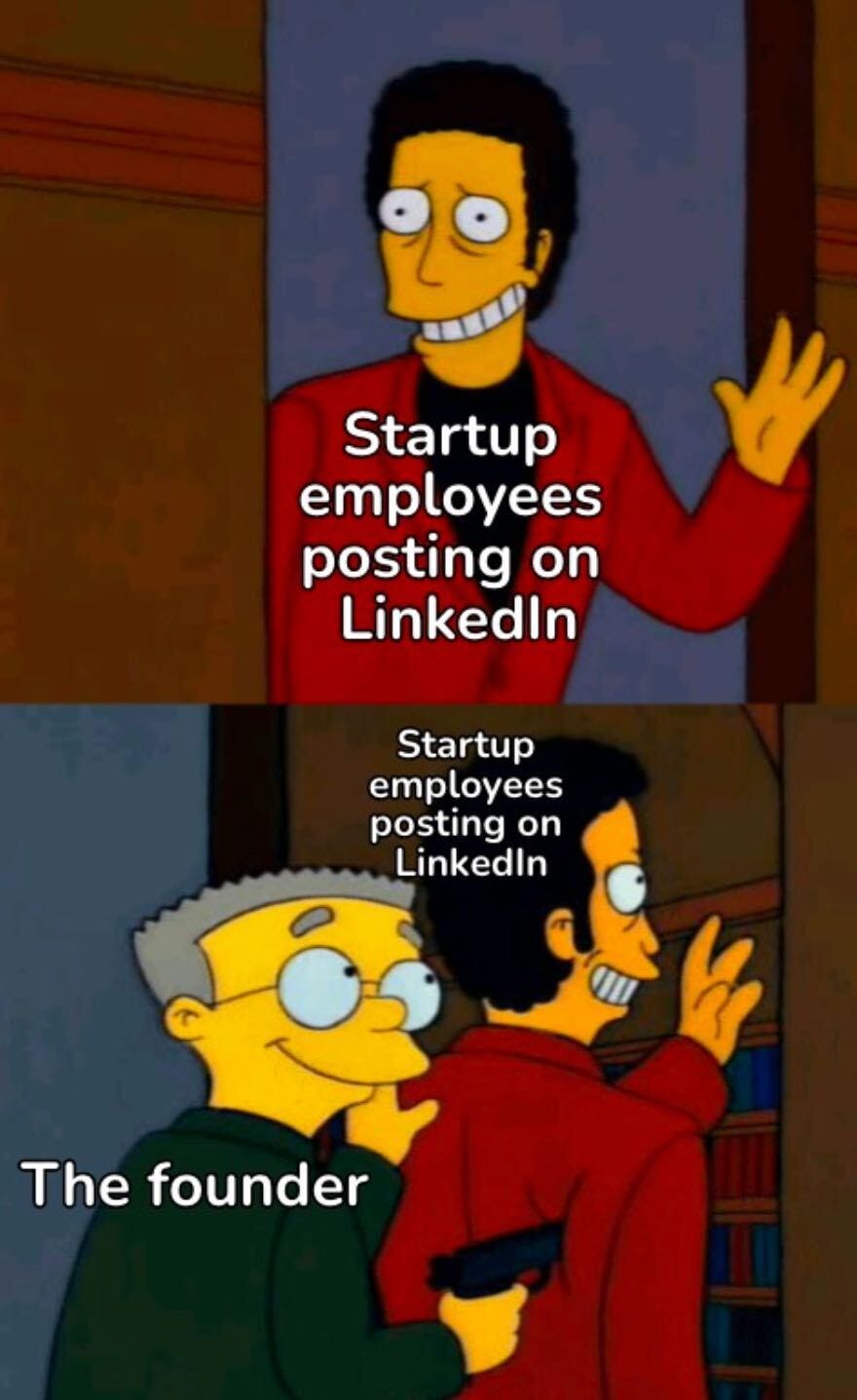
Every leader should be an evangelist for their business. But we’ve entered an era where posting vapid thought leadership on LinkedIn is the most effective way to evangelize a product. This pressures every founder to become a LinkedIn influencer. To be not just a business owner or product creator, but a brand themselves. They must turn their own likeness into an online media brand. They become the marketing entity that pushes their business forward.
There has been a shift in how people share content on LinkedIn. Over the last decade, LinkedIn has transformed itself from a work-focused networking site focused on jobs to a business-themed social media platform. It’s the social media platform you can scroll through during work hours and feel like you’re still “doing work stuff”, a tiny semblance of being productive. It feels somewhat better than scrolling Instagram or TikTok. It’s also still great for salespeople to hunt down prospects.
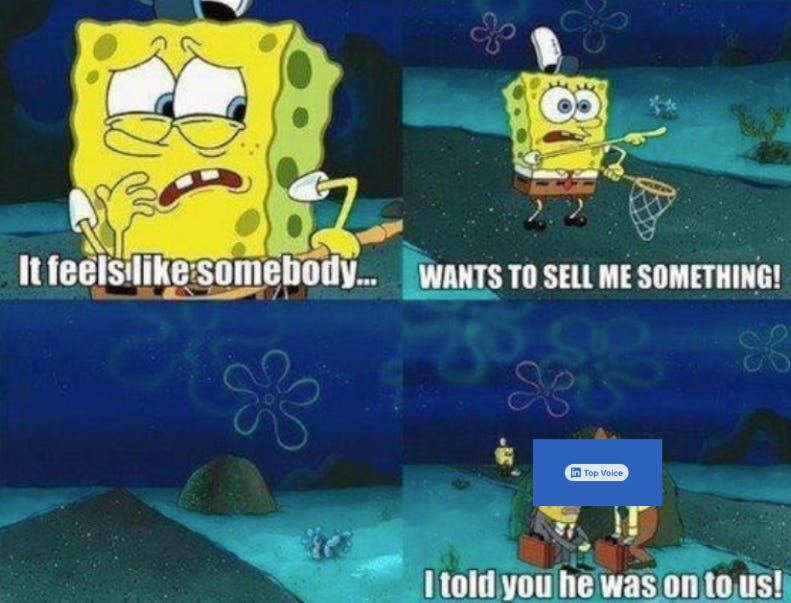
Previously, people would only share content on LinkedIn if it was important. If they had a big career announcement, reached an important milestone, or had an idea they truly felt they wanted to share. In our attention economy and the new LinkedIn, this is no longer the case. The LinkedIn creator does not come up with an interesting thought or achieve something that they then feel is worthy to share on LinkedIn. Instead they start with: I need to post something. I need to post X times per week. Let me brainstorm some ideas that would make good content. This fills LinkedIn with content that is created simply for the sake of needing to show up in feeds.
Every LinkedIn post is a not-so-veiled advertisement for the poster's personal brand and their company. This is apparent in the content of posts. Many LinkedIn creators end their posts with some kind of low-stakes call to action — comment below and I’ll send you the playbook, sign up for my newsletter, follow me for more, etc. These posts are not a person in your network sharing information they feel is meaningful. These are advertisements disguised as such.
Every LinkedIn post is: Hey look at me. Look at my face. See my friendly smile? Look, I'm being transparent and vulnerable. Don’t you trust me? Aren’t my ideas interesting? Do you like this hot take? Look at my job title and company name. Don’t you want to click on my profile to see what exactly my company does? Then the comments of these posts are filled with other LinkedIn creators leaving uninspired comments lauding the poster just to get their name and face attached to the post to get attention for themselves. This even goes so far as co-founders shitcommenting (like shitposting) on each other’s posts for engagement, or worse forcing lightly suggesting their employees to engage — like these people aren’t in Slack talking to each other all day. Like they aren’t planning the posts and what they’re going to comment together. It’s obvious and it’s pathetic. This is what I like to call The LinkedIn Circlejerk™.
Doing this has become popular because this nonsense actually does work. LinkedIn has become the most cost-effective marketing channel for B2B. No, not paid LinkedIn ads — those suck, but organic posts from real people. The LinkedIn algorithm has throttled the reach of company pages into the ground. They’ve decided that feeds need to be full of people. People with real faces, real ideas, real companies, and real job titles (the last two aren’t actually required).
It works because the eyeballs on LinkedIn are more valuable to B2B companies than any other social platform. People on LinkedIn have business goals and problems, with budgets to solve them. Just by showing up in feeds, LinkedIn influencers can get in front of target audiences and build trust with potential customers. When a person engages with a LinkedIn post, the post is then shown to people that person is connected with. This helps influencers reach new, relevant business audiences who may have never heard about the person or company before in a way that builds trust — someone they know is “vouching” for this person by engaging. This incentivizes creators to make engagement bait — bold hot takes, “inspiring” stories, faux vulnerability, recycled business lessons, toxic positivity (to the point of me worrying that you’re actually down bad), and even selfies. Personally, I think the random selfies attached to LinkedIn thought leadership posts are one of the funniest things on the internet. Keep it up.
Some startups are now hiring LinkedIn influencers for full-time marketing positions simply to attach their company name to the creator’s posts so their brand can show up in more feeds in an organic way. Many companies are even making thought leadership on LinkedIn part of the job description for both senior and junior marketing and sales roles.
Gong, a B2B sales tech company, invented the LinkedIn employee marketing playbook to help them grow a $7.5B valuation. The playbook is to essentially hold their junior employees hostage, forcing them to become thought leaders touting the company line. A real person. A real talking head. Showing up in your newsfeed. Talking about how great the company is. On LinkedIn, it looks good. The company appears to look like a rocket ship that all the employees are thrilled to be on. Engagement on posts from other employees or influencers all congratulate each other for sharing “insights”. But a quick scroll of through sales-related subreddits show that a lot of salespeople (their target customers) see through the bullshit and are nauseated whenever they see a post, especially those that have seen behind the curtain and have had underwhelming experiences using Gong’s products. These conversations can’t happen on LinkedIn. Unlike other social platforms, where creators who make disingenuous, corny, or outright bad content are called out — people on LinkedIn are disincentivized to call anyone out. Any negativity they bring to a post will be broadcasted to their entire network of connections. This is how LinkedIn creates the environment for The LinkedIn Circlejerk™. No one wants their boss, their coworkers, or customers to see them dunking on someone on LinkedIn even if the poster deserves it. There’s no shortage of tech companies that have adopted this employee marketing playbook, where employees must enthusiastically post about the company on LinkedIn to ensure their job security.
Advancements in AI-led software development tools are quickly making it so software companies no longer compete on product features. When everyone has the same product, or the ability to easily build a product, the way companies will differentiate and compete will be by brand — built through a race for the most attention. When the tasks that used to be done by a human worker are mostly done by AI, white-collar workers will find that an increasingly larger share of their job description involves creating content. The value the human will bring to the job is that they are a human and can be used as a marketing channel to establish trust by showing up in LinkedIn feeds. As AI decimates the white-collar job market, people will become more desperate for secure jobs and accept this reality.
A good friend of mine approached me about two years ago about starting a new company together. He wanted to make LinkedIn a core part of our go-to-market strategy — meaning he and I would post thought leadership consistently on LinkedIn. This made me deeply uncomfortable. I truly could not bring myself to do this. After a few beers on the roof of my apartment, I told him why this would be a dealbreaker for me: “Look man, I think this could be a good business opportunity and would of course love to take a shot starting a company together, but I have to tell you: Even if you told me right now that you could guarantee that if I created thought leadership posts on LinkedIn 5 days a week for the next year that I would get $1 million (in new business revenue or even profit) I would still say no.”
Now let me be clear. I am not a rich man. I do not have $1 million. But I don’t want $1 million that bad. Not bad enough to become a LinkedIn influencer. It’s not worth it to me. What these lunatics are posting on LinkedIn is so incredibly cringe and blatantly self-serving that I could not live with myself if I did the same. Even with $1 million I could not live with myself. (Theoretically, there is a number I sell my virtue, but it would be much higher.)
My friend and I didn’t end up going into business together, but he went down the path of posting on LinkedIn. Now he’s all badged up with a “Top Voice” designation on his profile. I’m genuinely happy for him and impressed he did it so quickly, but I have zero FOMO. I do not want to wear that badge.
I currently run a small B2B media company. We publish newsletters and run a website that is read by tens of thousands of business professionals every week. We have a loyal audience who enjoys our content. It’s a typical media brand with a name and logo. Neither myself nor my co-founder is the face of the brand. We’ve successfully run the company for four years without any personal brand.
As a niche business we have just a handful of real competitors. And I have to say, these competitors are absolutely smoking us in terms of influence, audience growth, and revenue. From what I’ve heard they’re probably doing about 2-3x our revenue. This is because they are creator-first media companies. The founders are LinkedIn influencers who are highly visible. I had a friendly chat with our biggest competitor about this. He admitted it was difficult being so visible, being the face of the brand, and showing up every day publicly on social (he’s also a LinkedIn Top Voice). He mentioned that he was a bit envious of my position, running a similar business without a public persona. I reminded him, “Yes, but you make way more money than I do.” He laughed, agreed, and posted some thought leadership on LinkedIn the next day.
My business partner and I have talked about this in depth. We both lean on the side of privacy. We don’t want to be business personalities. We don’t want to be LinkedIn influencers. We consciously made the decision, and continue to make it every day, to make less money as a business by opting not to become LinkedIn influencers. I just can’t make myself do it.